
WAFCON 2026: Cameroon crowned champions as Morocco finish fourth
The 2026 Women’s Africa Cup of Nations came to an end in Morocco on Sunday, August 16, with Cameroon making history by winning their first-ever continental title. The Indomitable Lionesses produced a commanding performance at the Moulay El Hassan Stadium in Rabat, beating Malawi 3-0 in the final to lift the trophy.
Cameroon make history in Rabat
After reaching the final by eliminating hosts Morocco on penalties, Cameroon completed their campaign in style. The Indomitable Lionesses dominated the final against Malawi and secured a convincing 3-0 victory, officially becoming African champions for the first time in the history of the women’s competition. The triumph capped a remarkable tournament for Cameroon and provided a memorable finale in Rabat.
Malawi finish runners-up
Malawi’s historic run came to an end in the final. The Scorchers had reached the decisive match for the first time after defeating Algeria 3-1 in the semi-finals. Although they could not complete their journey with the trophy, their run to the final represents a major milestone for Malawian women’s football.
Algeria claim the bronze medal
Morocco had to settle for fourth place after losing the third-place play-off to Algeria. The match ended 1-1 after regulation time, forcing the two teams into a penalty shootout. Algeria eventually prevailed 3-2 on penalties to secure the bronze medal. For Morocco, the result brought a disappointing end to a tournament played on home soil, particularly after the Atlas Lionesses had reached the previous two finals.
Individual awards
The tournament also ended with several individual honours:
- Player of the Tournament: Monique Ngock
- Top scorer: Temwa Chawinga
- Best goalkeeper: Michaely Bihina
- Fair Play Award: Algeria
With Cameroon crowned champions, Malawi finishing second and Algeria taking bronze, the 2026 WAFCON concludes with a historic result and another memorable chapter for women’s football in Africa.
For Morocco, meanwhile, the tournament leaves behind the legacy of a major continental football event hosted across the country, with Rabat providing the setting for a dramatic final weekend.

WAFCON 2026: Cameroon and Malawi reach the final after dramatic night in Rabat
Rabat delivered a memorable night of women’s football on Wednesday, August 12, as Cameroon and Malawi booked their places in the 2026 Women’s Africa Cup of Nations final. The two teams overcame Morocco and Algeria respectively, setting up an unexpected final for Sunday, August 16.
Malawi makes history against Algeria
The first semi-final at Rabat’s Olympic Stadium was already historic before kick-off. Neither Algeria nor Malawi had previously reached this stage of the Women’s AFCON.
Malawi eventually made history with a 3-1 victory over Algeria, producing a performance that took the Scorchers into their first continental final.
The result confirms Malawi’s remarkable run in Morocco and gives the team a chance to compete for its first major African title.
Cameroon ends Morocco’s home dream
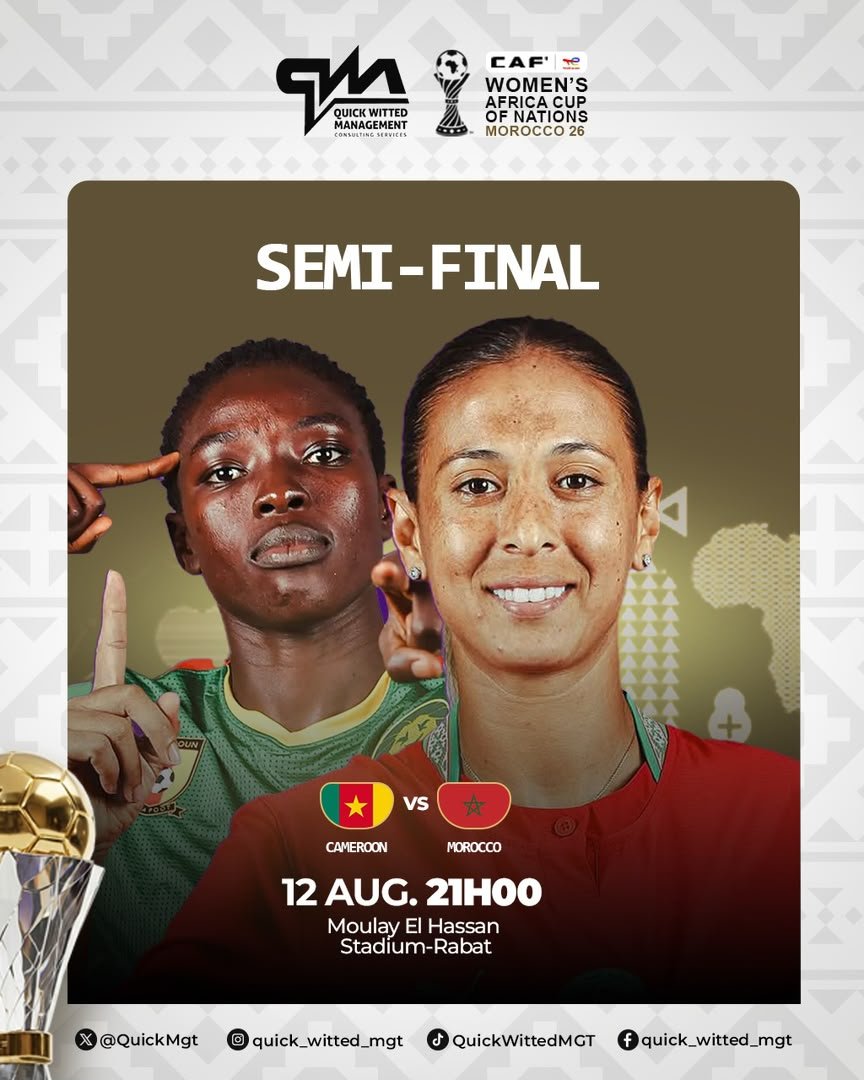
The second semi-final provided another major twist. Morocco, runners-up at the previous two editions, faced Cameroon with a place in the final at stake. Despite playing on home soil, the Atlas Lionesses could not find a way through a tightly contested encounter.
After a goalless 90 minutes, the semi-final was decided by a penalty shootout. Cameroon prevailed 3-1 on penalties, ending Morocco’s hopes of reaching a third consecutive final.
The result was particularly painful for the hosts, who had been hoping to lift the trophy in front of their home supporters.
A final Morocco did not expect
The outcome means that Cameroon will face Malawi in the WAFCON 2026 final on Sunday, August 16. Both finalists have taken different paths to the decisive match, but each has produced a major upset in the semi-finals.
Cameroon eliminated the host nation, while Malawi defeated Algeria in a historic encounter. For visitors and football fans in Morocco, Sunday’s final will provide another major occasion in what has been a highly competitive tournament.
Rabat prepares for the final
The elimination of Morocco means the final will not feature the hosts, but the tournament will remain in Rabat for its climax. Cameroon and Malawi will now compete for African women’s football’s biggest prize, with both sides looking to turn an extraordinary semi-final performance into continental glory. The final promises to be a historic encounter regardless of the outcome, with two teams now just one victory away from writing their names into WAFCON history.
Morocco vs Cameroon ticket row: What need to know ahead of the WAFCON semi-final
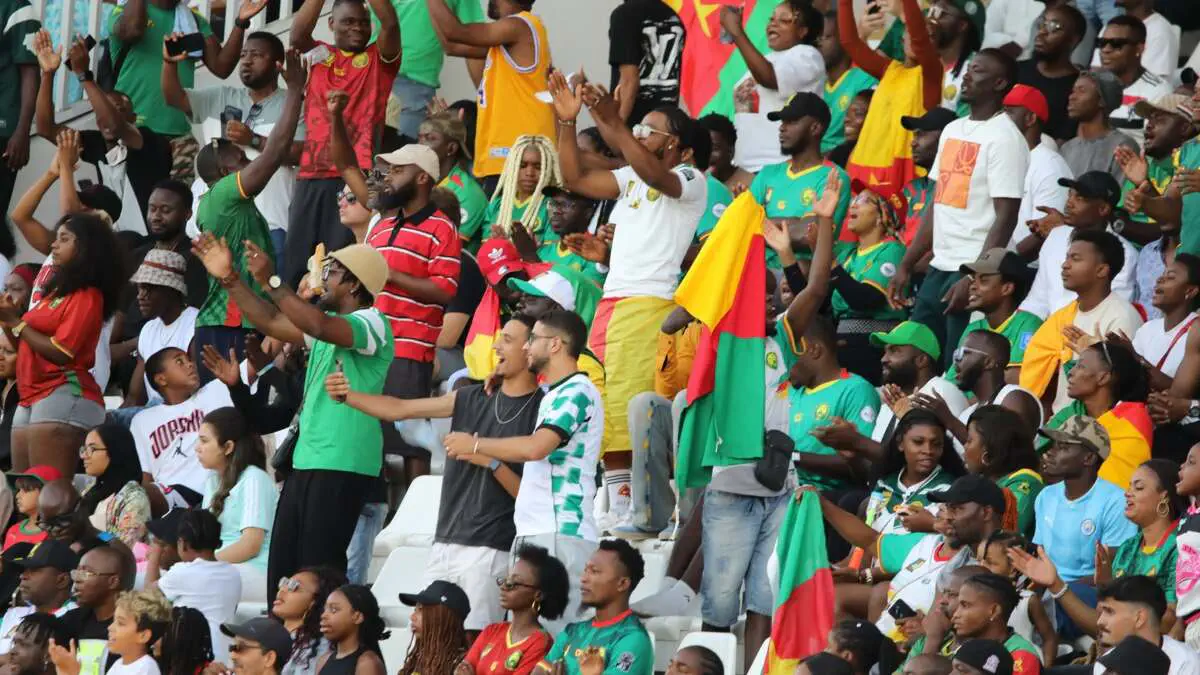
As Morocco and Cameroon prepare to meet in the semi-finals of the 2026 Women’s Africa Cup of Nations, ticket availability has become an unexpected talking point ahead of the highly anticipated match in Rabat.
Cameroon’s ambassador to Morocco, S.E. Mouhamadou Youssifou, has requested a quota of 1,000 tickets for Cameroonian supporters. The situation has prompted questions among fans, but the ticketing difficulties should be viewed in the broader context of how the tournament’s ticketing system operates.
CAF oversees the WAFCON ticketing system
One of the key points to understand is that ticketing for the 2026 WAFCON is handled within the official framework established by the Confederation of African Football (CAF).
The continental governing body operates the official ticketing platform and its dedicated customer service system. The Royal Moroccan Football Federation (FRMF) therefore does not have sole authority over ticket allocation or sales.
This distinction is important when assessing the current situation surrounding the Morocco-Cameroon semi-final.
No measure targeting Cameroon supporters
There is no indication of a specific measure designed to prevent Cameroonian fans from attending the match.
The limited availability should not be interpreted as evidence of a discriminatory policy, a political decision or an instruction targeting supporters of the Indomitable Lionesses.
The broader objective remains to allow as many supporters as possible from both teams to attend one of the biggest matches of the tournament.
Why tickets are difficult to find
Demand is a major part of the explanation.
Morocco is hosting the competition and support for the Atlas Lionesses has been particularly strong throughout the tournament. Large numbers of local fans have followed the team, while tickets for highly anticipated matches were reserved early.
With Morocco now one game away from reaching the WAFCON final, demand for the semi-final has naturally increased.
Limited availability is therefore primarily a question of stadium capacity and exceptionally high demand, rather than an attempt to keep Cameroonian supporters away.
Cameroon has requested 1,000 tickets
The Cameroonian embassy has formally requested 1,000 tickets for supporters travelling to or living in Morocco.
The request covers 50 Category 1 tickets and 950 Category 3 tickets.
Discussions are now taking place between the relevant stakeholders, including CAF and the local organising committee, to explore ways of facilitating access to the stadium for supporters of both national teams.
A football occasion for Morocco and Cameroon
The ticketing issue comes at a particularly sensitive moment, with both teams preparing for a crucial knockout match.
Morocco reached the last four after beating South Africa, while Cameroon produced one of the biggest results of the tournament by eliminating Nigeria.
The semi-final is therefore expected to attract considerable attention both inside Morocco and across Africa.
Rather than allowing the ticket issue to overshadow the sporting occasion, the focus is now on finding practical solutions for supporters.
The relationship between Morocco and Cameroon goes beyond football, with longstanding ties between the two countries. The semi-final should ultimately reflect that spirit: a celebration of African football featuring two major football nations, both competing for a place in the WAFCON final.

Women’s AFCON 2026: Morocco reach semi-finals and secure World Cup qualification
Morocco’s Atlas Lionesses have reached the semi-finals of the 2026 Women’s Africa Cup of Nations on home soil, securing their place at the 2027 FIFA Women’s World Cup in Brazil. With the tournament now entering its decisive stage, Morocco remains at the centre of a historic edition of African women’s football.
Morocco book their place in Brazil
Morocco’s run at the 2026 Women’s AFCON has delivered another major milestone for the national team.
The Atlas Lionesses secured their place in the semi-finals after defeating South Africa 2-1 in the quarter-finals. The result also guaranteed Morocco one of Africa’s four direct tickets to the 2027 FIFA Women’s World Cup.
The achievement comes three years after Morocco made history at the 2023 Women’s World Cup, reaching the round of 16 on their debut.
The 2027 edition in Brazil will therefore mark the second consecutive appearance at the global tournament for the Atlas Lionesses.
A major football event hosted by Morocco
As hosts, Morocco have been at the heart of the 2026 Women’s AFCON.
The tournament has provided an opportunity to showcase the country’s football infrastructure while bringing some of Africa’s leading women’s teams together.
For visitors following the competition, the tournament also offers a chance to discover Morocco beyond the football pitch, from the atmosphere of Rabat to the country’s historic cities, cultural heritage and diverse landscapes.
The capital has been one of the key locations during the competition, hosting major matches as the tournament moves towards its decisive stages.
Four teams qualify for the 2027 World Cup
Morocco are not the only African team heading to Brazil.
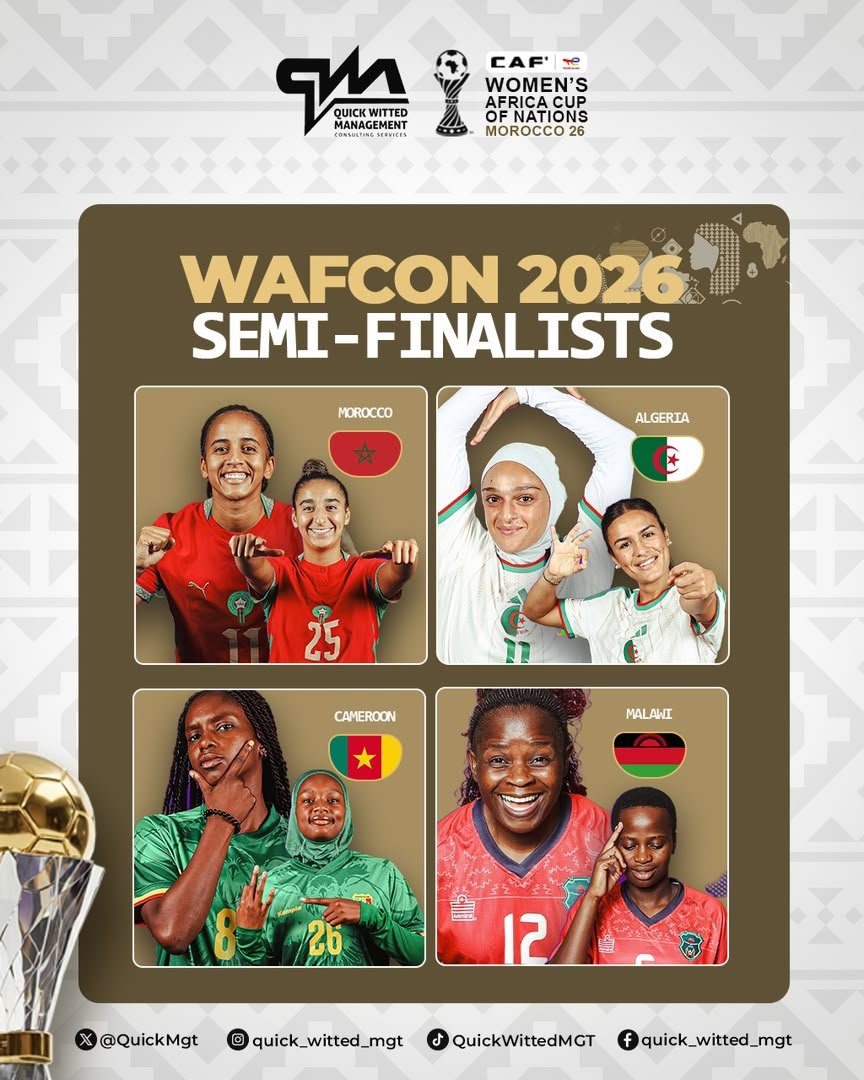
The other three semi-finalists — Algeria, Cameroon and Malawi — have also secured direct qualification for the 2027 FIFA Women’s World Cup.
Algeria made history by reaching the global tournament for the first time after defeating Côte d’Ivoire 2-1 in the quarter-finals.
Cameroon booked their ticket by eliminating defending champions Nigeria with a 1-0 victory.
Malawi completed the semi-final line-up after producing one of the tournament’s biggest surprises, beating Ghana 2-1. The result also gave the Scorchers their first-ever qualification for the Women’s World Cup.
Morocco face Cameroon for a place in the final
The semi-final stage promises another major occasion for Moroccan football fans.
The Atlas Lionesses will face Cameroon for a place in the final. Playing in front of a home crowd will add another dimension to Morocco’s challenge as the team looks to turn home advantage into continental success.
The other semi-final will see Algeria take on Malawi, with both sides already celebrating historic World Cup qualification.
The two matches will determine the finalists of an edition that has already produced several landmark moments.
Africa could send six teams to Brazil
Although the four semi-finalists have secured Africa’s direct World Cup places, the continent could ultimately have up to six representatives at the 2027 tournament.
The four teams eliminated in the quarter-finals still have a route to the World Cup through CAF play-offs.
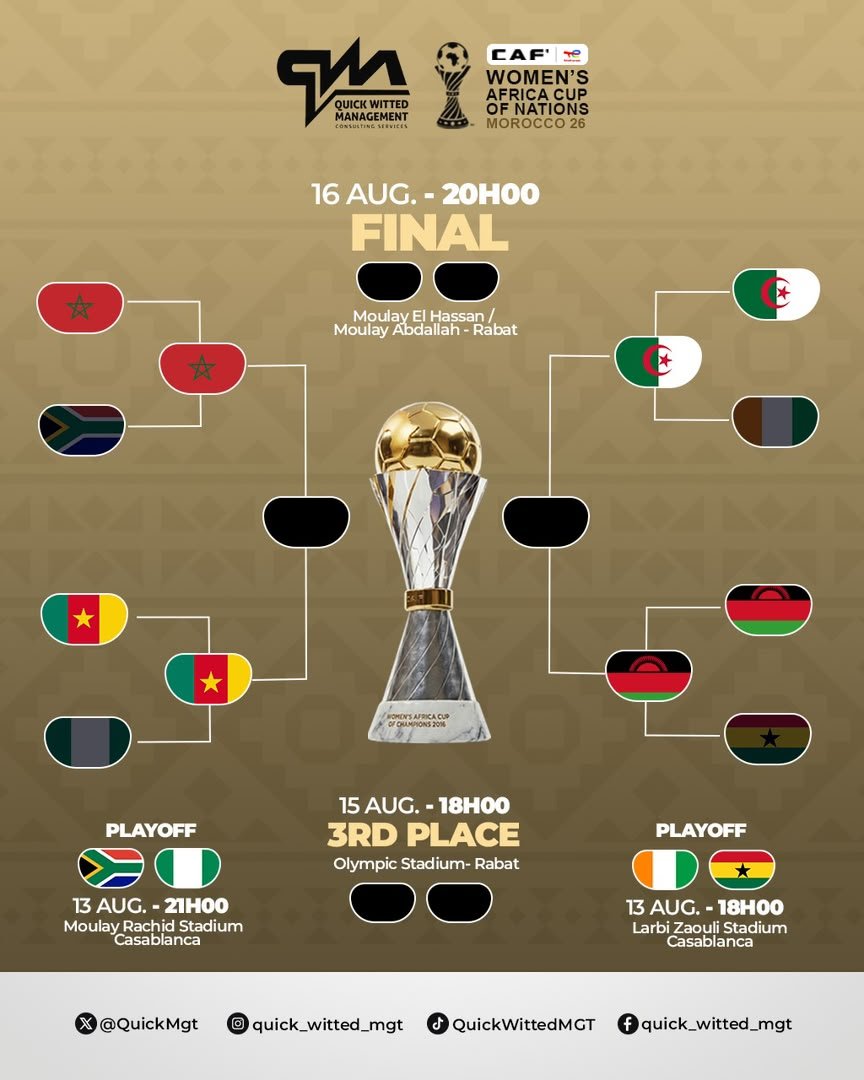
Côte d’Ivoire will meet Ghana, while Nigeria will face South Africa. The two winners will advance to FIFA’s intercontinental play-offs, where they will compete for one of the final World Cup places.
This means the 2026 Women’s AFCON is not only determining the continental champion. It is also playing a crucial role in shaping Africa’s representation at the next Women’s World Cup.
Another milestone for Moroccan women’s football
For Morocco, the tournament represents another step in the rapid development of women’s football.
The Atlas Lionesses’ historic run at the 2023 World Cup transformed expectations around the team. Their continued progress on home soil in 2026 now offers another opportunity to strengthen Morocco’s position among Africa’s leading women’s football nations.
With the semi-finals approaching, attention is turning to Rabat and the decisive matches that will determine who reaches the final.
For fans travelling to Morocco, the final stages of the Women’s AFCON provide an opportunity to combine top-level African football with the country’s rich cultural, historical and tourism attractions.

Amidst the AFCON, Morocco’s new initiative to boost women’s football
While the Atlas Lionesses are currently competing in the Women’s Africa Cup of Nations (WAFCON) 2026 on home soil, the Royal Moroccan Football Federation (FRMF) is continuing its long-term strategy to develop women’s football across the Kingdom.
During a meeting held on Monday under the leadership of Fouzi Lekjaa, the federation announced a new measure aimed at strengthening the foundations of Moroccan women’s football and improving its competitiveness at continental and international level.
The meeting also provided an opportunity for the president of the National Women’s Football League to present a positive assessment of recent seasons, highlighting the progress made by clubs, national teams and the gradual expansion of women’s football participation in Morocco.
A promising transformation since 2020
Since 2020, Morocco has undertaken a major transformation of its women’s football structure.
The professionalisation of competitions, improved organisation and increased support for clubs have allowed the Kingdom to accelerate its development and close part of the gap with Africa’s most established football nations.
This progress has been reflected in the performances of the Atlas Lionesses, who have reached the final of the last two editions of the Women’s Africa Cup of Nations and have established themselves among the leading teams on the continent.
The FRMF now wants to continue this professionalisation process until the end of 2026, with a particular focus on improving club structures and giving greater importance to youth development.
A dedicated technical department for women’s football
One of the key decisions announced by the federation is the creation of a dedicated women’s football unit within the National Technical Directorate.
This new structure will be responsible for coordinating player identification, training programmes and the development of coaches working in women’s football.
Its main objective will be to expand the pool of talented players available for Morocco’s national teams and ensure a stronger pathway from grassroots football to the highest level.
The initiative reflects the FRMF’s ambition to build a sustainable model rather than relying only on the success of the senior national team.
Greater autonomy for national leagues from December
Starting at the end of December, Morocco’s national leagues are also expected to benefit from greater management autonomy.
This change aims to improve decision-making processes and create an organisational framework better adapted to the specific needs of each competition.
For the FRMF, strengthening the governance of women’s football is a key step toward ensuring long-term growth and maintaining Morocco’s position among Africa’s top football nations.
Beyond WAFCON 2026: preparing the next generation of Atlas Lionesses
As Morocco hosts the Women’s Africa Cup of Nations 2026, the message from the federation is clear: the achievements of the current generation must serve as a foundation for the future.
The performances of the Atlas Lionesses on the international stage have increased the visibility of Moroccan women’s football, but the FRMF wants to ensure that this momentum continues through stronger development programmes.
With the creation of a specialised technical unit and continued investment in training, Morocco is aiming to establish a lasting model capable of producing future generations of talented players and competing consistently at the highest level.

2030 World Cup: FIFA denies rumors of a promise to host the final in Morocco
FIFA has officially dismissed reports claiming that President Gianni Infantino promised Morocco the right to host the 2030 FIFA World Cup final. Calling the allegations « false » and « misleading », world football’s governing body has reaffirmed that no decision has yet been made on the venue for the tournament’s showpiece match. While the clarification ends speculation, it also shifts attention to the transparent process that will ultimately determine where the centenary final will be played.
FIFA Rejects the Rumours
Speculation surrounding the 2030 FIFA World Cup final has prompted an official response from FIFA.
The governing body has categorically denied reports suggesting that Gianni Infantino privately guaranteed Morocco the right to stage the tournament’s final.
Describing the claims as « false » and « misleading », FIFA stressed that no commitment has been made regarding the venue of the final.
The clarification comes after widespread reports and social media discussions suggested that Morocco had already secured the most prestigious match of the centenary tournament.
No Decision Has Been Made
FIFA’s statement makes one point clear: the host of the 2030 World Cup final has not yet been chosen.
Morocco will co-host the historic tournament alongside Spain and Portugal, while Uruguay, Argentina and Paraguay will stage the opening centenary matches. However, FIFA has yet to announce which stadium will welcome the final.
The governing body has therefore sought to dispel speculation before the official selection process reaches its conclusion.
A Historic Decision Still Ahead
The 2030 FIFA World Cup will mark 100 years since the inaugural tournament in Uruguay, making the choice of the final venue particularly significant.
Whether the final is ultimately awarded to Morocco or Spain, the decision is expected to carry symbolic, sporting and logistical importance for one of the most historic editions of the competition.
For Morocco, which has invested heavily in football infrastructure and is preparing to co-host its first FIFA World Cup, the focus remains on delivering a successful tournament across all host cities.
Transparency Will Be Key
With the rumours now officially dismissed, attention is likely to turn toward the criteria FIFA will use to select the final venue.
A transparent and merit-based process would reinforce confidence in the organisation and ensure that the decision reflects sporting, technical and operational excellence.
For Morocco, the priority remains unchanged: successfully co-hosting the 2030 FIFA World Cup and contributing to a historic tournament that connects Africa, Europe and South America through football.

WAFCON 2026: Quarter-final test for Morocco’s title ambitions
Morocco’s Atlas Lionesses will face South Africa in the WAFCON 2026 quarter-finals in a highly anticipated clash between two ambitious African women’s football nations. The match represents more than a knockout tie — it showcases the rapid growth and rising profile of women’s football across the continent.
Morocco chasing historic success
Playing in front of their home supporters, the Atlas Lionesses are aiming to go further after establishing themselves as one of Africa’s emerging women’s football powers.
Morocco reached the final in previous editions and is looking to turn recent progress into a first continental triumph.
South Africa bring continental pedigree
Standing in their way are South Africa’s Banyana Banyana.
The South Africans remain one of the continent’s strongest teams after winning their first WAFCON title in 2022.
A celebration of African football
The quarter-final highlights the growth of women’s football in Africa.
Morocco’s investment in facilities and development programmes, combined with South Africa’s competitive consistency, reflects the increasing strength of the women’s game across the continent.
More than a rivalry
While both teams will fight for a place in the semi-finals, the match should also be viewed as a celebration of African excellence.
Morocco and South Africa are carrying the hopes of a continent that continues to invest and believe in women’s football.

Morocco focuses on governance as FIFA crisis deepens
As FIFA faces its biggest governance crisis in years, Morocco is working to protect its growing reputation as a leading football nation by emphasizing institutional governance, transparency and African football development rather than personal support for any individual leader.
Morocco at the centre of football diplomacy
The withdrawal of the controversial FIFA Forward Enterprise proposal has intensified tensions within world football.
At the same time, Morocco has hosted high-level FIFA discussions, reinforcing its role as an important diplomatic hub for global football.
Balancing leadership and neutrality
Some African football leaders, including Royal Moroccan Football Federation president Fouzi Lekjaa, are widely viewed as part of Gianni Infantino’s support base.
However, Morocco’s broader message remains focused on institutional credibility rather than personal alliances.
Protecting the 2030 World Cup project
With Morocco set to co-host the 2030 FIFA World Cup alongside Spain and Portugal, preserving confidence in football governance has become a strategic priority.
Officials continue to emphasize transparency, integrity, African football development and respect for governance standards as essential pillars of the tournament’s legacy.
Looking beyond the current crisis
For Morocco, the challenge is to remain a trusted venue for dialogue while avoiding becoming associated with FIFA’s internal political divisions.
By promoting institutional governance over personalities, Rabat hopes to reinforce its long-term vision for African and global football.

Ceuta: Morocco prioritizes cooperation after the migration tragedy
Following the tragedy in Ceuta, Morocco is emphasizing a response focused on protecting human lives, caring for minors, and strengthening cooperation with Spain, while urging the public to avoid speculation about the causes of the crisis.
Saving Lives Comes First
In the aftermath of the tragic events in Ceuta, Moroccan authorities have reaffirmed that their foremost priority is protecting people—particularly minors—and preventing further human tragedies.
The Kingdom also reiterates its commitment to continuing operational cooperation with Spain to ensure the return of migrants in accordance with established procedures and to combat the criminal networks involved in irregular migration.
Investigations Rather Than Accusations
As allegations of migration being used as a political tool circulate in public debate, Rabat is calling for a focus on verified facts rather than speculation.
The preliminary findings available so far point primarily to the activities of smuggling networks and the spread of false information that encouraged many people to attempt the dangerous crossing.
A Call for Responsibility
Morocco stresses the importance of maintaining a coordinated approach with Spain to strengthen border security while protecting vulnerable populations.
« The Ceuta tragedy calls for facts, humanity, and cooperation—not speculation, » the Moroccan authorities emphasized.

2026 WAFCON: Host nation Morocco secures a quarter-final spot ahead of Algeria
Morocco’s women’s national team has reached the knockout stage of the Women’s Africa Cup of Nations (WAFCON) 2026, after a dramatic final matchday in Group A on Monday, August 3. Playing in front of their home supporters, the Atlas Lionesses earned a crucial point against Senegal to confirm their place in the quarter-finals, while Algeria joined them in the next round after a comfortable victory over Kenya.
Morocco’s football journey continues on home soil
The atmosphere was electric at the Moulay El Hassan Stadium, where thousands of Moroccan fans gathered to support the host nation. Morocco dominated large parts of the encounter against Senegal, creating several chances but struggling to break through a well-organised Senegalese defence. The home side came closest to opening the scoring after being awarded a penalty, but the opportunity was missed. Despite the frustration in attack, the goalless draw was enough to secure Morocco’s qualification and keep their dream of winning the continental title alive in front of their supporters.
Algeria completes Group A qualification
In the other decisive Group A fixture, Algeria delivered a professional performance against Kenya, securing a 2-0 victory. The result allowed the Algerian team to finish the group stage strongly and book their place among the eight best teams of the tournament.
Group A final results
- Kenya 0-2 Algeria
- Senegal 0-0 Morocco
Morocco and Algeria move into the quarter-finals
With their qualification confirmed, Morocco and Algeria will continue their WAFCON 2026 campaign, while Senegal and Kenya exit the competition after the group stage.
For Morocco, the qualification represents another important milestone in a tournament where the country is aiming to combine sporting success with the enthusiasm generated by hosting Africa’s biggest women’s football competition. The Atlas Lionesses will now turn their attention to the quarter-finals, hoping to go all the way on home soil.