
Fouzi Lekjaa reframes institutional prerogatives following the appointment of Abderrahim El Arjoun.
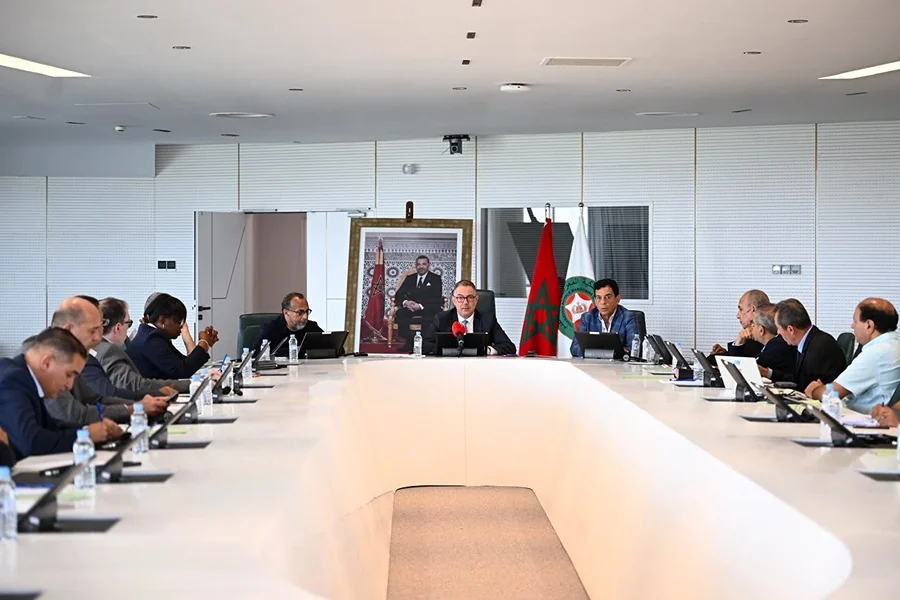
Clarifying the institutional framework and strengthening governance mechanisms constitute essential pillars to guarantee fairness in national sporting competitions. Ten days after his controversial appointment by the Professional League, the new head of the National Refereeing Directorate, Abderrahim El Arjoun, presented his first strategic briefing on Monday, 9 November 2026, before the Executive Committee of the Royal Moroccan Football Federation. Chaired by Fouzi Lekjaa, this official meeting recalled federal primacy over the overall management of the refereeing body and clarified the executive role devolved to partner leagues. During this working session, the federal presidency reaffirmed the requirement for enhanced continuous training to elevate the technical level of young officials and prepare a new generation capable of supporting the ongoing modernization of national football.
Clarification of prerogatives and referral to the Ethics Commission
This institutional address comes in a context marked by jurisdictional boundaries between the professional league and the supreme federal body. Following the replacement of Redouane Jiyed, the federal meeting served to recall statutory provisions governing match officials across the entire national territory. Furthermore, the federation’s presidency formally instructed the league to refer to the Ethics Commission all club press releases containing public accusations that undermine the integrity of match officials. This approach aims to reconcile the legitimate right of clubs to submit technical claims with the essential protection of competition integrity against untimely statements.
Impact on sports ethics and league credibility
The pursuit of impeccable governance within football bodies contributes directly to enhancing the sporting spectacle and the economic appeal of national tournaments. By consolidating the independence of refereeing and establishing a structured dialogue with club executives, sports authorities strengthen the confidence of commercial partners, investors, and broadcasters. A professional championship governed by strict transparency rules elevates the international profile of the Botola and guarantees fair competition conditions for all stakeholders. By asserting institutional rigour and the integrity of sports management, the country solidifies the credibility of its organizational model and supports the overall prominence of national sport.