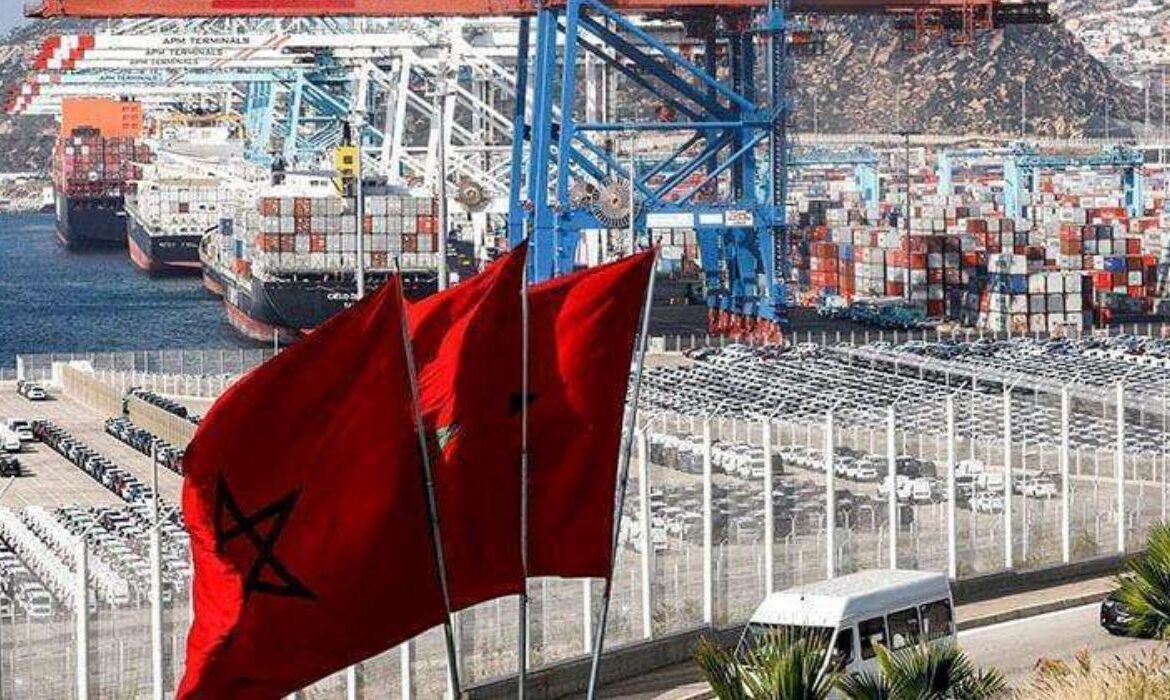
The Kingdom of Morocco has officially become Africa’s most industrialized economy in 2025, overtaking South Africa for the first time, according to a new report by the African Development Bank (AfDB). The shift marks a significant turning point in Africa’s industrial landscape and reflects two contrasting trajectories: Morocco’s long-term industrial expansion strategy and South Africa’s gradual economic slowdown.
A Two-Decade Industrial Strategy Pays Off
According to the AfDB report, Morocco’s rise is the result of a sustained industrial policy launched over the past 20 years, combining heavy public investment, targeted foreign direct investment, and the development of export-oriented industrial zones.
A key driver of this transformation has been the expansion of major infrastructure projects, particularly the port of Tanger Med, now considered the largest and most competitive port in Africa. Its logistics capacity has turned Morocco into a strategic gateway between Europe, Africa, and the Americas.
The country’s industrial base has also diversified significantly. While phosphates and automotive manufacturing remain important pillars, new high-value sectors such as aerospace have emerged as major contributors to industrial output.
Aerospace and Automotive at the Core of Growth
Industry experts highlight Morocco’s growing role in global supply chains, particularly in aviation. “Every aircraft flying today that was produced after 2005 includes at least one essential component manufactured in Morocco,” said Abdelmalek Alaoui, president of the Moroccan Institute of Strategic Intelligence and author of Morocco, the Challenge of Power.
He noted that Morocco’s industrial leap reflects a strategic national bet on both the automotive and aerospace sectors, supported by strong infrastructure and export integration.
A Model Built on Infrastructure and Investment
The AfDB report emphasizes that Morocco’s industrial success is closely linked to sustained investment in high-quality infrastructure, including ports, industrial zones, transport connectivity, and telecommunications. This environment has attracted increasing levels of foreign investment while also encouraging domestic private-sector growth. However, analysts warn that the model is highly dependent on continued capital inflows and global demand for manufactured exports.
Persistent Regional Inequalities
Despite its industrial achievements, Morocco continues to face deep internal disparities.
According to economists cited in the report, the benefits of industrialization are unevenly distributed across the country. Coastal and urban regions integrated into global trade networks have seen the strongest growth, while inland and rural areas lag behind.
“There is a winning Morocco, close to ports and global markets, and another Morocco at the margins,” noted Abdelmalek Alaoui. “This accelerated industrialization has widened the gap between the wealthiest and the most vulnerable populations.”
Employment Challenge Remains
A separate AfDB analysis published last month also highlighted a structural weakness in Morocco’s economic model: its limited job creation capacity relative to the size of its workforce. While the country hosts a growing number of companies and export industries, employment growth has not kept pace with demographic pressures, raising concerns about long-term social inclusion.
A New Industrial Hierarchy in Africa
Morocco’s ascent signals a broader reshaping of Africa’s industrial hierarchy, traditionally led by South Africa due to its mining base and diversified manufacturing sector. The new ranking reflects shifting investment flows, infrastructure competitiveness, and integration into global value chains—trends that are expected to continue shaping the continent’s economic geography in the coming years.