AFCON 2025: Digital Surge as Morocco’s FAN ID Registration Hits 2 Million in Hours
The launch of the FAN ID application process for the 2025 Africa Cup of Nations (AFCON) in Morocco has triggered an unprecedented digital rush. According to exclusive data reported by Rue20, nearly two million requests were submitted within just a few hours after the platform went live — a historic moment for African football.
Record Demand Reflects Global Enthusiasm
Never before has a fan identification system generated such enthusiasm across the continent. The FAN ID, required to purchase tickets and obtain an entry e-Visa for Morocco, has quickly become the most sought-after credential among African and international fans.
This overwhelming demand reflects the unprecedented anticipation for AFCON 2025, touted as the most modern and innovative edition ever hosted on African soil.
YALLA Platform Overwhelmed by Early Demand
The official digital hub, YALLA, developed to manage both FAN ID issuance and e-Visas, experienced technical slowdowns and a temporary outage due to the massive early influx of users.
In response, the organizing committee and CAF have scaled up infrastructure to restore normal operations and maintain service stability. This marks a first for CAF, which is now fully embracing advanced digital tools to ensure a secure and streamlined fan experience.

Key Stats: 92,000 Accounts Created, 56,000 FAN IDs Approved in 20 Hours
Despite technical hiccups, the numbers are impressive:
- 92,000 user accounts activated on the YALLA platform,
- 56,000 FAN IDs successfully validated — all within the first 20 hours.
This rapid pace confirms both the platform’s efficiency and the global interest in the tournament.
Morocco Gearing Up for a Historic AFCON
Scheduled from December 21, 2025, to January 18, 2026, AFCON 2025 is shaping up to be one of the most anticipated editions in the tournament’s history. With modernized infrastructure, digitally enhanced services, and record-breaking international engagement, Morocco is redefining the African football experience.
The host cities — including Casablanca, Rabat, Marrakesh, and Tangier — are set to deliver a tournament that blends innovation, passion, and world-class organization.
Africa’s Football Goes Digital
From integrated e-Visa systems to fully connected FAN ID technology, AFCON 2025 is ushering in a new digital era for major sporting events on the continent.
The YALLA app promises a 100% connected experience, placing security, efficiency, and fan engagement at the heart of the tournament — a bold step forward for African sports management.

AFCON 2025: Ticket Sales Open October 13 with Exclusive Visa Pre-Sale Access
Rabat – October 13, 2025 | The countdown has officially begun for African football fans: the official ticket sales for the 2025 Africa Cup of Nations (AFCON)—set to take place in Morocco—will open on Monday, October 13 at 08:00 GMT. The Confederation of African Football (CAF) and the Morocco 2025 Organizing Committee have confirmed a 48-hour exclusive pre-sale for Visa cardholders.
Two-Phase Ticket Sales: Visa Holders Get Early Access
For the first 48 hours, only fans with a Visa payment card will be able to purchase tickets through the official platform. This exclusive pre-sale, a result of CAF’s partnership with Visa, marks a new milestone in AFCON ticketing history.
Starting October 15, the platform will open to the general public, allowing purchases through all available payment methods, both within Morocco and internationally.
YALLA App Required: Fan ID and e-Visa Mandatory
All tickets must be purchased via the official YALLA mobile application, which is poised to become the digital hub of AFCON 2025. Fans must:
- Download the YALLA app,
- Create their personal Fan ID,
- Obtain a mandatory e-Visa to complete their purchase and gain stadium entry.
This innovation is designed to streamline stadium access, enhance spectator safety, and modernize the fan journey, offering a fully digital, secure experience.
A Historic AFCON Returns to Morocco
From December 21, 2025, to January 18, 2026, Morocco will host the 35th edition of the Africa Cup of Nations—its first time since 1988. The tournament will take place across several host cities, including:
- Casablanca,
- Rabat,
- Marrakech,
- Tangier,
- and other key locations.
Morocco aims to deliver a world-class football celebration, combining cutting-edge technology, top-tier organization, and unmatched fan energy.
Ticket Sales Signal Key Milestone in AFCON 2025 Preparations
The opening of ticket sales marks a major step forward in the tournament’s build-up and showcases Morocco’s organizational momentum. With millions of fans expected—both in stadiums and online—AFCON 2025 is set to be a landmark event for African football.

Yalla: The Moroccan App Set to Revolutionize AFCON 2025
Rabat – October 2025 | With just months to go before the 2025 Africa Cup of Nations (AFCON) kicks off, Morocco is preparing to offer an unprecedented digital experience for football fans through the upcoming launch of Yalla, a mobile app designed to deliver a 100% connected, personalized, and immersive tournament.
A Different Kind of AFCON: Technology, Service, and Passion
Set to host its first AFCON since 1988, Morocco is aiming to redefine how supporters experience the tournament. With Yalla, fans will have access to all services related to the competition right from their smartphones—making the 2025 edition much more than just a football event.
Tickets, Visas, and Exclusive Services in One App
Designed as a one-stop platform, Yalla will allow fans to:
- Purchase official match tickets with ease,
- Manage visa applications for international supporters,
- Access personalized services, including hotel bookings, local transport, and tourist experiences tied to the competition.
A New Standard in Digital Immersion
More than a logistical tool, Yalla is set to deliver a fully interactive and immersive fan experience, featuring:
- Exclusive content (behind-the-scenes footage, interviews, training sessions),
- Real-time engagement during matches (live polls, quizzes, fan chats),
- Augmented reality features to bring fans closer to the action—no matter where they are in the world.
Morocco: Showcasing a Digitally-Driven African Football
This initiative highlights Morocco’s ambition to make AFCON 2025 the most innovative edition in the tournament’s history. Yalla is part of a broader push to digitize sports experiences, making fans central to the event and reinforcing Morocco’s image as a modern, forward-looking host nation.

A Global App Designed for Local and International Fans
Whether attending matches in Moroccan stadiums or watching from thousands of kilometers away, fans will be able to experience AFCON through Yalla. The app will be available in multiple languages (Arabic, French, English) and built with a user-friendly interface accessible to all.
A Strategic Tool for Morocco’s Global Image
With the launch of Yalla, Morocco isn’t just upgrading a sports tournament—it’s sending a strong signal to the world: the Kingdom is ready to host major international events, backed by advanced digital infrastructure, a clear commitment to innovation, and a vision for the future.
Royal Speech to Parliament : Roadmap for a Fairer, More United Morocco
Rabat, October 11, 2025 – His Majesty King Mohammed VI, accompanied by HRH Crown Prince Moulay El Hassan and HRH Prince Moulay Rachid, presided over the opening of the first session of the fifth legislative year of the 11th Parliament on Friday. In a solemn address, the King outlined the nation’s strategic priorities, calling for the acceleration of territorial development programs and a results-oriented approach to governance.
Full Text of the Royal Speech
« Praise be to God,
May peace and blessings be upon the Prophet, His Family, and His Companions.
Honourable Members of Parliament,
With the help of the Almighty, we open today the final legislative year of the current term of the House of Representatives.
This occasion offers us the opportunity to reaffirm the value we place on your work—whether legislative in nature, related to the oversight of government action, or the evaluation of public policies.
We also commend the efforts made to enhance the performance of partisan and parliamentary diplomacy in order to better serve the higher Causes of the Nation. In this regard, we call for a more diligent and effective approach, based on cooperation and complementarity with official diplomacy.
As this marks the final year of your mandate, we urge you to carry out your duties with seriousness and responsibility. Complete the legislative processes underway, implement the programs and projects in progress, and remain vigilant and committed in advocating for the citizens’ cause.
Furthermore, there should be no contradiction or competition between major national projects and social programs, as long as the shared objective is to develop the country and improve the living conditions of citizens, wherever they may be.
In the same vein, special attention must be paid to citizen guidance and communication surrounding the initiatives undertaken by public authorities, as well as the various laws and decisions, especially those directly affecting citizens’ rights and freedoms.
This mission is not the government’s responsibility alone. It is a collective duty—and you, Members of Parliament, are on the front lines, as representatives of the people.
This is also the responsibility of political parties and elected representatives at all levels of territorial governance. Media outlets, civil society actors, and, more broadly, all of the Nation’s vital forces must also be involved.
Honourable Members of Parliament,
In the most recent Throne Speech, we called for an acceleration in the path toward an emerging Morocco, and for the launch of a new generation of territorial development programs.
As you know, these are major challenges that extend beyond the temporal limits of governmental and parliamentary action.
Thanks be to God, thanks to the momentum we have initiated, our country is advancing steadily toward greater social and territorial justice.
We are equally committed to ensuring that the fruits of growth benefit everyone, and that all children of a unified Morocco enjoy equal political, economic, social, and other rights.
We consider the level of local development to be the true mirror of the progress of the emerging and united Morocco whose stature we all strive to consolidate.
Indeed, the dual objective of « social justice and the fight against territorial inequalities » is far from being an empty slogan or a temporary priority whose significance might diminish over time.
Rather, we regard it as a strategic orientation requiring the commitment of all actors—and a crucial issue that must underpin all development policies.
Moreover, the path laid out for emerging Morocco to achieve social and spatial justice demands the mobilization of all available potential.
The profound transformation we seek in territorial development requires a major shift in mindset and working methods, as well as a deep-rooted culture of results. This approach must be grounded in accurate field data and the use of digital technologies.
As for the new generation of territorial development programs that the government is expected to design in line with our guidelines, we expect them to be swifter in execution and more impactful in their results. This work must respect a win-win relationship between urban and rural areas.
These are the key issues we have identified as priorities, foremost among which are:
- Promoting local initiatives and economic activities
- Creating employment opportunities for youth
- Effectively advancing the education and health sectors
- Implementing territorial upgrading
And since any negligence affecting the efficiency and profitability of public investment is unacceptable, we urge everyone, at their respective levels, to combat all time-consuming, energy-wasting, and resource-draining practices.
In addition to the directives in our Throne Speech on territorial development, we call for particular focus on the following points:
First:
To devote special attention to regions in a state of extreme vulnerability, particularly mountainous areas and oases, while taking into account their specificities and needs.
Indeed, harmonious territorial development cannot be achieved without effective solidarity and complementarity among various areas and regions.
In this respect, it is essential to reconsider the development of mountainous areas, which cover 30% of the national territory. These regions must be supported through an integrated public policy that reflects their unique characteristics and rich potential.
Second:
To ensure the optimal operationalization of sustainable development tools for the national coastline, including the Coastal Law and the National Coastal Plan.
The objective is to strike the necessary balance between the rapid development of these areas and the imperative of protecting and showcasing their immense assets—within the framework of a national maritime economy that generates wealth and jobs.
Third:
To expand the National Program for the Development of Emerging Rural Centers as a suitable mechanism for managing urbanization and reducing its negative effects.
These emerging centers can become effective links in the drive to provide rural citizens with local administrative, social, and economic services.
Honourable Members of Parliament,
The coming year is filled with projects and challenges.
We therefore expect all of you—government and Parliament alike, both Majority and Opposition—to mobilize all energies and resources, and to prioritize the higher interests of the Nation and its citizens.
May God guide you to be worthy of the trust placed in you and up to the responsibility you bear. Uphold integrity, commitment, and selflessness in the service of your country.
The Almighty says: “So whoever does an atom’s weight of good will see it, and whoever does an atom’s weight of evil will see it.”
Truthful is the Word of God.
Wassalamu alaikum wa rahmatullahi wa barakatuh.
History Made : Morocco’s Cubs Defeat Brazil and Spain
Morocco had never beaten Brazil at the U20 level—until now. That chapter is officially closed. The Cubs pulled off a stunning feat against the Seleção, just days after dominating Spain. These two victories mark a major turning point in the history of Moroccan and African football.
A Double Victory with Continental Significance
This achievement goes beyond Morocco. It symbolizes the rise of African football as a whole. Few nations on the continent had ever managed to bring down such giants. Morocco now joins this elite circle, signaling that a new era is beginning for African football.

Standout Talents Make the Difference
Amid this collective triumph, individual brilliance shone through. Yassine Jassim, who plays for US Dunkerque, once again stood out, earning the MVP title just as he did against Spain. His consistency and vision make him the technical leader of the Cubs. In goal, Yanis Benchaouch made multiple crucial saves, proving that Africa now has a generation of goalkeepers capable of competing with the world’s best.
Africa Looks to the Future with Confidence
These results reinforce the belief that the continent no longer suffers from an inferiority complex. With its consecutive victories, Morocco is showing the way, proving that Africa can rise to the global stage—even against the biggest footballing nations.

90 Days to Go: Morocco Gears Up for Africa Cup of Nations 2025
Monday, September 22, 2024, marks the 90-day countdown to the Africa Cup of Nations (AFCON) 2025, and anticipation is building across the continent. Morocco, the host nation, is putting the final touches on stadiums, training facilities, and logistics to ensure a seamless tournament. National teams are finalizing their squads and strategies, while fans across Africa are eagerly following preparations and speculating onpotential stars. With state-of-the-art venues and robust infrastructure, Morocco is set to welcome thousands of supporters from across the continent. Beyond football, AFCON 2025 promises to be a celebration of African culture, unity, and sporting excellence, making it one of the continent’s most eagerly awaited events.

Over 4,000 Volunteers to Power TotalEnergies CAF Africa Cup of Nations Morocco 2025
The Confederation of African Football (CAF) and the Local Organizing Committee (LOC) in Morocco have officially launched the volunteer program for the TotalEnergies CAF Africa Cup of Nations Morocco 2025, offering more than 4,000 individuals a once-in-a-lifetime opportunity to play a vital role in Africa’s most prestigious football tournament. Registrations are open now through October 8, 2025, and applications can be submitted at volunteers.cafonline.com. Anyone aged 18 and above is eligible to apply.
Be Part of Africa’s Biggest Sporting Event
Set to take place from December 21, 2025, to January 18, 2026, across six Moroccan cities and nine stadiums, the 2025 edition is expected to be one of the largest and most impactful tournaments in AFCON history. With millions of fans anticipated across host cities, the event offers a powerful platform for volunteers to contribute meaningfully while gaining valuable professional and personal experience.
What Volunteers Will Do
Selected volunteers will be assigned to various functional areas, including:
- Media operations
- Spectator services
- Accreditation
- Hospitality
- Fan support and reception
- Logistics and operational assistance
This initiative aims to empower African youth through professional engagement and exposure to high-level event operations.
Skills, Training & Certification
The program is not just about service—it’s about building capacity and developing future leaders in sport and event management. Volunteers will receive:
- Comprehensive training in their specific roles
- Professional development opportunities
- Official CAF uniforms
- Certificates of participation
All activities will be conducted in alignment with CAF’s core values: integrity, professionalism, and discipline.
Key Dates to Remember
- Volunteer registration opens: September 17, 2025
- Application deadline: October 8, 2025
- Training and selection: October – November 2025
- Tournament operations: Mid-December 2025 – January 18, 2026
Why Join?
Joining the volunteer program means becoming part of a pan-African movement, connecting with people from across the continent, and contributing to the legacy of Africa’s most celebrated football event.
Volunteers will gain hands-on experience, build international networks, and have the satisfaction of supporting an event watched by millions across the globe.
How to Apply
Apply now at : volunteers.cafonline.com
Deadline: October 8, 2025
AFCON 2025: Morocco Ready to Welcome Africa in 100 Days
The 2025 Africa Cup of Nations is fast approaching: in exactly 100 days, Morocco will host one of the continent’s most prestigious sporting events. The highly anticipated 35th edition is set to officially kick off on December 20, 2025.
This Friday, September 12, marks a symbolic milestone in the countdown to this major African football event. The Confederation of African Football (CAF), national teams, fans, and organizers are intensifying preparations to deliver what the host country promises will be an “emblematic, unique, and majestic” tournament.

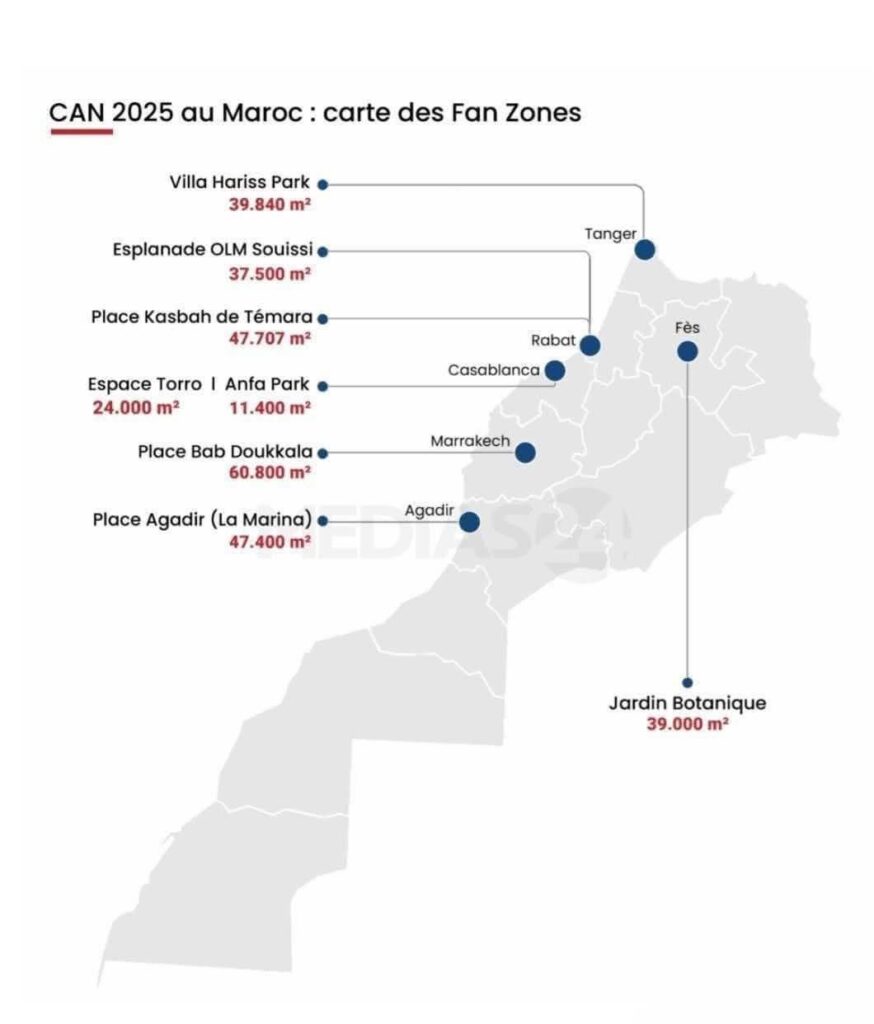
Morocco, renowned for its solid sports infrastructure and proven experience in hosting international events, is gearing up to welcome Africa’s top teams across several cities, including Casablanca, Rabat, Marrakech, Fès, and Agadir. CAN 2025 is set to be a landmark moment on the African sports calendar, combining high-stakes competition, passionate crowds, and global visibility.

CAF launches official ticketing website for 2025 Africa Cup of Nations in Morocco
The Confederation of African Football (CAF) has officially launched the website dedicated to ticket sales for the 2025 Africa Cup of Nations (CAN), scheduled to take place in Morocco from December 21, 2025, to January 18, 2026.
Although ticket sales have not yet begun, this platform is an important first step for fans wishing to attend one of the continent’s biggest sporting events. Fans can now register on the website to receive all the official information about the sales schedule and booking procedures.
The link is as follows : https://tickets.cafonline.com/en
This approach aims to ensure better organization and avoid any inconvenience associated with the high demand expected. The early launch of this site also allows for the centralization of all ticket-related operations, ensuring greater transparency and security for buyers.
The 2025 AFCON in Morocco promises to be an exceptional edition, featuring the best African teams and played in modernized stadiums, including the new sports complex in Rabat and the future Grand Stade de Casablanca.
With this initiative, CAF and the Moroccan organizing committee are demonstrating their commitment to putting fans at the heart of the competition and offering a seamless and accessible experience that lives up to the event.
Here is the website : https://tickets.cafonline.com/en
The stadiums for the 2025 Africa Cup of Nations in Morocco
With the 2030 World Cup approaching, Morocco, as co-host alongside Spain and Portugal, has launched its infrastructure revolution with the aim of building the best stadiums. The first full-scale test will be the 2025 Africa Cup of Nations, just a few months away, with nine stadiums in six cities now ready for competition. This is the first time such a complex will be set up for an Africa Cup of Nations tournament.
Prince Moulay Abdellah Stadium (Rabat)
The pride of the kingdom’s political capital, the Prince Moulay Abdellah Stadium, built in 1983, has undergone numerous renovations to remain on par with the largest African venues. For the 2025 Africa Cup of Nations, work has focused on installing a latest-generation hybrid turf, completely updating the stands, modernizing the VIP boxes, and renovating the media areas.
Already accustomed to hosting major events, it hosted the final of the 2022 Women’s Africa Cup of Nations and matches of the 2023 Club World Cup. FAR Rabat plays there regularly, and the stadium is also one of the venues for the 2030 World Cup. It will be the venue for the opening match, guaranteeing an exceptional atmosphere.
In the meantime, the match between Morocco and Niger on the seventh day of qualifying for the 2026 World Cup will be the stadium’s first event since its reopening on September 5.
Grand Stade de Marrakech
Opened in 2011, the Grand Stade de Marrakech is one of the most beautiful complexes in the Maghreb, nestled at the foot of the Atlas Mountains. For the 2025 Africa Cup of Nations, the “Ochre City” has strengthened its infrastructure by improving security, modernizing the changing rooms, and optimizing the VIP areas. This stadium has already hosted African Champions League matches and Botola Pro fixtures as the home ground of Kawkab Marrakech. It will welcome several major nations throughout the group stage, ensuring record attendance in a city renowned for its fervor and hospitality.
Capacity: 45,000 seats
Completion date: June 10, 2025
Teams: Angola (2 matches), Zimbabwe (2 matches), South Africa (2 matches), Ivory Coast (3 matches), Gabon, Cameroon, Mozambique, one eighth-final, one quarter-final.
Mohammed V Stadium (Casablanca)
The legendary Mohammed V Stadium, nicknamed “Donor” by the people of Casablanca, is the soul of Moroccan soccer. Built in 1955, it has been modernized several times, most recently for the 2025 Africa Cup of Nations, with a complete facelift of the stands, LED lighting upgrades, and media areas worthy of major international competitions. Home to Raja and Wydad, this stadium is a volcano on match nights. It has hosted many major events, including the Club World Cup.
Capacity: 67,000 seats
Completion date: operational before 2025
Teams: Mali, Zambia, Comoros (2 matches each), Burkina Faso, Equatorial Guinea, Sudan (2 matches each), one eighth-final, third-place play-off
Moulay El Hassan Stadium (Rabat)
Located in the capital, the Moulay El Hassan Stadium is named after the crown prince and has been completely modernized for the 2025 Africa Cup of Nations. Now able to accommodate nearly 22,000 spectators after its renovation, it has been fitted with a brand new roof, a high-end turf, and a state-of-the-art LED lighting system. It is also scheduled to host the 2030 World Cup. Its versatility will enable it to host major athletics competitions in the future. Initially, it only hosted Botola and Moroccan Cup matches as the home ground of FUS Rabat.
Capacity: 22,000 seats
Completion date: end of August 2025
Teams: Algeria (3 matches), Mozambique, Sudan, Burkina Faso, one round of 16 match
Al Barid Stadium (Rabat)
The capital’s new stadium, Al Barid Stadium stands out for its more modest size but optimal comfort. Built specifically to strengthen Rabat’s stadium offering, it is primarily intended for group matches. Its compact architecture guarantees a warm atmosphere close to the pitch.
Capacity: 18,000 seats
Completion date: end of August 2025
Teams: DR Congo (2 matches), Benin, Botswana, Uganda, Tanzania, one round of 16 match
Adrar Stadium (Agadir)
Opened in 2013, Adrar Stadium is the jewel of southern Morocco. Known for hosting the U17 Africa Cup of Nations and the Club World Cup, it is home to Jeunesse Sportive d’Agadir. For the 2025 Africa Cup of Nations, work has focused on modernizing access, enhancing security, and upgrading media facilities. It will also feature on the list of stadiums for the 2030 World Cup.
Capacity: 45,000 seats
Completion date: June 10, 2025
Teams: Gabon (2 matches), Cameroon (2 matches), Mozambique (2 matches), Egypt (3 matches), Angola, Zimbabwe, South Africa, one eighth-final, one quarter-final
Fez Sports Complex Stadium
The Fez Stadium, inaugurated in 2007, is a benchmark for soccer in the center of the country. Home to MAS Fez, it has already hosted Throne Cup finals and major Botola matches. For the 2025 Africa Cup of Nations, it has benefited from an optimized pitch and a redesign of the stands for greater comfort. It has also been selected for the 2030 World Cup.
Capacity: 45,000 seats
Completion date: June 10, 2025
Teams: Nigeria (3 matches), Uganda, Tanzania, Tunisia, one round of 16 match
Ibn Batouta Stadium (Tangier)
With a capacity of 75,600, the Grand Stadium of Tangier, named after the legendary Moroccan explorer Ibn Batouta, is one of the largest venues in Africa. Built in 2011, it was recently transformed to remove the athletics track and bring the stands closer to the pitch. Home to Ittihad Tangier, it has hosted prestigious matches such as the Spanish Super Cup and the former Club World Cup. It will be a key venue for the 2025 Africa Cup of Nations and the 2030 World Cup. For the World Cup, it is set to be expanded further, with a capacity of around 100,000.
Capacity: 75,600 seats
Completion date: September 2025
Teams: Senegal (3 matches), Botswana, DR Congo, Benin, one eighth-final, one quarter-final, one semi-final
Rabat Olympic Stadium (Moulay Abdellah Annex)
An annex of the large Moulay Abdellah complex, the Olympic Stadium is a more intimate venue that has been completely renovated for the Africa Cup of Nations. With a capacity of 21,000, it will provide the ideal setting for group matches, where the proximity to the pitch will thrill spectators.
Capacity: 21,000 seats
Completion date: August 2025
Teams: Tunisia (2 matches), Uganda, Tanzania, Benin, Botswana
Some photos