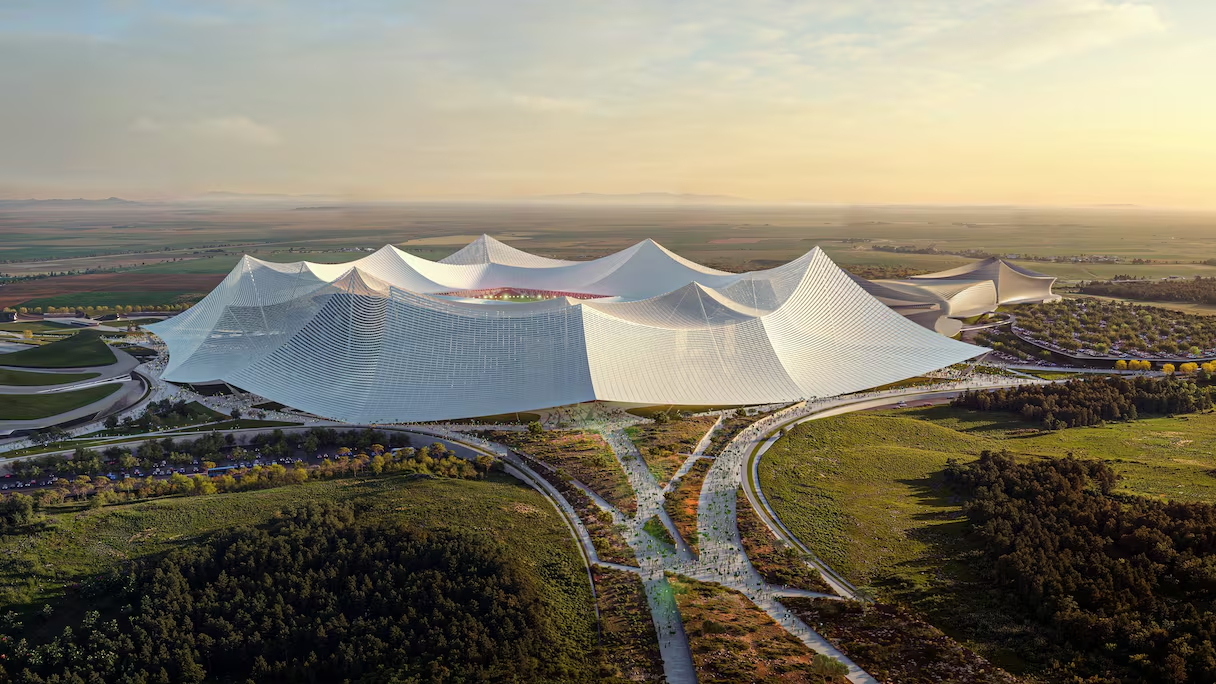
As co-host of the centenary tournament, the Kingdom is counting on the Hassan II Grand Stadium to host the final.
Preparations for this historic edition of the World Cup are mobilising the country’s full technical and organisational capabilities. As co-host of the 2030 World Cup alongside Spain and Portugal from 8 June to 21 July, Morocco is preparing to take part in this unprecedented centenary tournament, which will begin with three opening matches in South America before spreading across both sides of the Mediterranean. At the heart of the national sporting infrastructure lies the future Hassan II Grand Stadium, currently under construction in the Casablanca region with a projected capacity of 115,000 spectators and due for completion by the end of 2027. Building on the success of the Africa Cup of Nations hosted on home soil between December 2025 and January 2026, the Kingdom is highlighting its six selected venues, including the Prince Moulay Abdellah Stadium in Rabat and the Grand Stade de Tanger, whilst defending – through the voice of the president of the Royal Moroccan Football Federation, Fouzi Lekjaa, the legitimacy of Casablanca’s bid against Spanish ambitions to host the tournament’s showpiece match, the official award of which will be decided by the International Federation of Association Football following the inspection mission expected in late November.
Key infrastructure extending far beyond sports venues
Hosting this global event is acting as a real catalyst for regional development and the overall modernisation of the country’s transport networks. The investment programme is supporting the completion of major projects that extend beyond the sporting sphere alone, such as the extension of the high-speed rail line linking Kenitra to Marrakech, the expansion of airport and port capacity, and the roll-out of major water management projects. This integrated vision ensures smooth travel for delegations and the millions of visitors expected, whilst providing the regions concerned with modern facilities designed to meet citizens’ needs in a sustainable manner.
Benefits for local employment and tourism appeal
The simultaneous implementation of these large-scale projects generates sustained economic momentum, benefiting national engineering, construction and public works companies, and fostering the creation of tens of thousands of direct and indirect jobs, as well as enhancing the skills of the local workforce. Hosting the World Cup final would provide the Kingdom with unprecedented media exposure, consolidating its image as a leading events and tourism hub. In the long term, the physical and human legacy of this competition will stimulate private investment, boost the hospitality and service sectors, and enhance Morocco’s economic appeal on the international stage.