
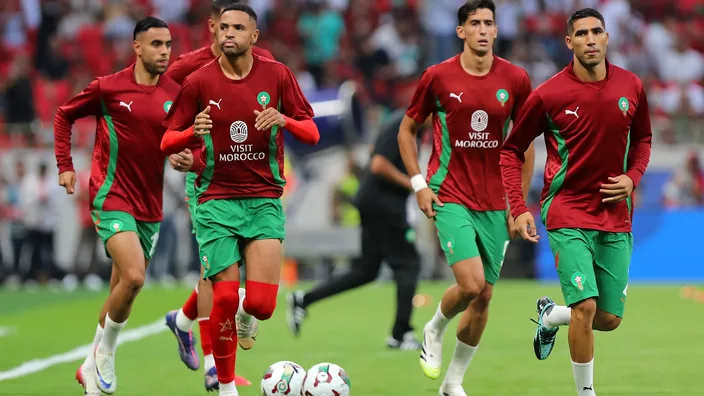
Beyond their opponents, the Atlas Lions face another major challenge at the 2026 World Cup: the heat. In Houston, Atlanta, Miami and Monterrey, high temperatures and humidity put the players’ bodies under severe strain and force the teams to adapt their preparations.
In several host cities across the United States and Mexico, temperatures regularly exceed 35°C. For medical staff and fitness coaches, the aim is now to protect the players’ bodies whilst maintaining a high level of performance.
Hydration and recovery at the heart of preparations
Faced with these weather conditions, the national teams have radically altered their working methods. Training sessions are held early in the morning or in the evening to avoid the hottest part of the day, whilst players follow personalised hydration protocols before, during and after each session.
Weight, hydration levels and recovery indicators are also monitored daily. According to experts, a footballer can lose between one and two litres of water during a 90-minute match, or even more when temperatures and humidity levels are particularly high.
Technologies to combat the heat
Recovery has become an essential part of performance. Several teams now use cooling vests, cooling jackets or other equipment specifically designed to rapidly lower body temperature after exercise.
These devices help to limit the effects of heat stress, delay the onset of fatigue and speed up recovery between different phases of play.
Cooling breaks during matches also play a strategic role. They give players a few minutes to rehydrate, recover physically and receive the latest tactical instructions.
A factor that can make all the difference
For physical preparation experts, acclimatisation to climatic conditions has become just as important as tactical or technical work. Several national teams arrived in North America several days before their opening matches to allow players to adapt gradually to the heat.
As the competition progresses and fatigue sets in, managing extreme temperatures could become a decisive factor. For the Atlas Lions, who are still in contention in this 2026 World Cup, being able to withstand the heat could prove to be an additional asset in their quest for another remarkable achievement.